The Laramie Project, demonstrating the importance of storytelling
Updated: Jul 28

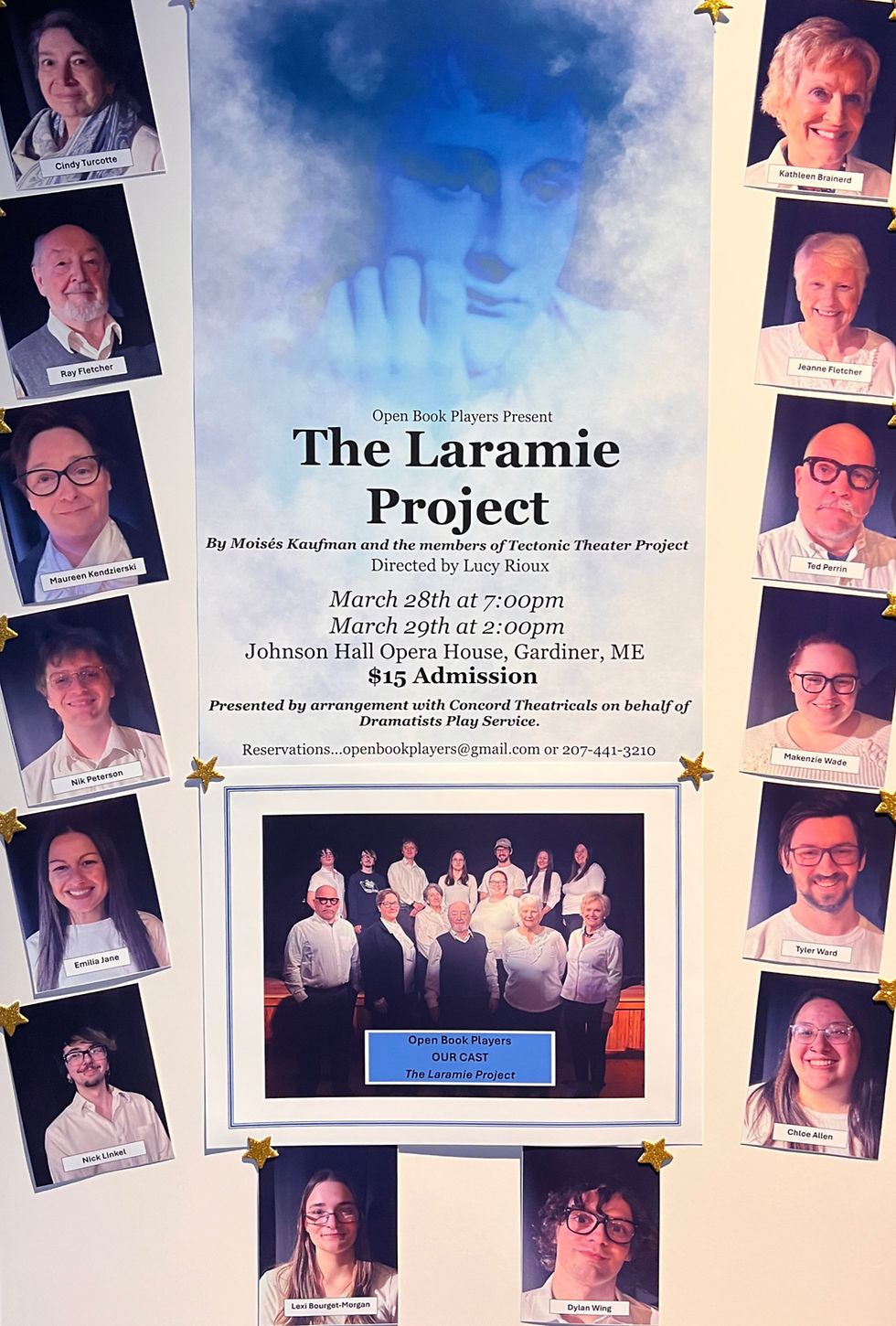
On March 28th and 29th at Johnson Hall Opera House, the Open Book Players performed
The Laramie Project. While the show was just a little over two hours long, the impact that the story leaves on any audience lasts much longer.
Reader's theater
Reader's theater is a style of performance where actors are stationary at arranged places with a script. They are literally reading the show they are performing.
While the performer's physical movement is limited, their emotion, impact, and storytelling is not. The cast of fourteen that told this story in March on the Logan Stage radiated passion and a deep understanding of the message they were communicating.
What is The Laramie Project?
The Laramie Project is a documentary style play written from entirely true events. It was created by Moises Kaufman and members of the Tectonic Theater Project, in response to the murder of a gay college student named Matthew Shephard in 1998. Matthew lived in the town of Laramie, Wyoming, and the aftermath of his murder is exposed in this emotional play. It delves into themes of grief, injustice, and the ways that such a small town handled being in the spotlight of the entire nation for the wrong reasons.
What the performers have to say
Before the show began, I had the opportunity to speak with several performers and director Lucy Rioux. I asked them questions regarding their perception of the show and what it meant for them to be a part of it.
Ted
The first actor I interviewed is Ted Perrin.
I began by asking him, out of all of the differing perspectives that are highlighted in the show, which one resonated with him the most?
Ted replied by telling me that he resonated most strongly with Matthew Shephard's father's perspective. He explained to me that he could not perform that part of the show without crying, thinking about his own kids and nephew. Ted has gay family members and he expressed his worry for them with the state of the world and the political climate. When Matthew was killed, he remembers hearing the story and being horrified, but not looking into it at the time.
Ted has experience with theater and has performed in many shows prior to The Laramie Project, and as an actor myself, I find that there is always a specific message that I take away from any show I'm in that stays with me. To follow up my first question, I asked him what will stay with him from this particular performance and/or rehearsal process. He confessed being a "literature nerd," and shared with me his amazement at how well the script is written and put together. He emphasized how he was impressed with the way it was stitched together and edited, and said that that would stick with him from his participation in the show.
Nik
I also had the chance to speak with actor Nik Peterson.
When performing in any show, the rehearsal process is deeply immersive and sometimes intense. This show is no different. I asked Nik how he chose to prepare himself for being a part of The Laramie Project and telling such a heavy story. He explained that upon reading through the show for the first time, director Lucy Rioux gave the cast an overview of the history of the show and experiences she's had directing it in the past. He also did research on his own time.
I ended my interview with Nik by asking him why he believed that the stage is a good vessel for all of the messages that The Laramie Project carries. He replied by explaining that the theater community and the LGBTQIA community inherently overlap, so this environment is a good place to discuss such topics.
Lucy
"We live in an adversarial situation right now where people are not considered to be equal."
Lucy Rioux directed the performance of The Laramie Project, and is celebrating thirty years of directing reader's theater.
I inquired about her reasons for selecting this show and why it felt important to do so. Lucy said that since reader's theater is celebrating its 30th anniversary, she chose this show because it had been performed before and had really made an impact that meant something. The last time she directed this show, herself and the cast members were targeted by multiple church groups that did not want the show to be performed. To Lucy, choosing The Laramie Project was a no brainer because of what's happening in the world today. She wanted to bring it back to make a statement.
I asked next, what do you hope audiences take away from this show?
Lucy replied by saying she hoped the message stayed with people. She said that if anything else, the play shows what can happen if people don't treat others the right way, emphasizing the fact that we are not equal in the state of the world around us.
Last, I asked Lucy what moments in the rehearsal process stood out to her. She recalled reading through the script for the first time and noticing actor Ted crying. She said it reminded her of the weight of the show and that it's not known what anyone has experienced in the past. She was also amazed at how well each person fell into their character, whether they were playing the good, the bad, or the ugly.
"We are like this. We ARE like this. WE are LIKE this."
Each member of the cast of fourteen read for at least three parts, working together to tell a riveting and solemn story. Many individual messages within the show stayed with me, but one in particular stood out.
Zubaida Ula went to the University of Wyoming and lived in Laramie at the time of Matthew Shepard's murder, and is a prominent character in the play. She is a strong feminist and an immigrant from Bangladesh. The story she tells individually is one of a young woman who is frustrated with her town and the story that its people are trying to tell to the rest of the world. When she noticed the townspeople making an effort to prove that Laramie isn't the kind of town where bad things happen, she spoke out. Ula was confused at why the people of Laramie didn't own the murder of Matthew Shephard and their deep rooted ignorance. She believed that the only true way to move forward is to confront the discomfort of the crime, insisting that Laramie is the kind of town where things like this happen. Otherwise, why did it happen there?
Ula's character has a powerful repeating line in the play. "We are like this. We ARE like this. WE are LIKE this." Played by Chloe Allen in the reader's theater production, Zubaida Ula's insistence on looking into the past to find the why and to heal can be applied to any community that experiences hatred. Only once it is acknowledged that there is a reason something is allowed to occur, can we move forward in healing from it.
This can even be tied into Lucy's prior experience directing The Laramie Project, being targeted by church groups and being made to fear that the performance wouldn't be possible. It goes to show that hatred and ignorance have a home even in our small corner of the world. Recognizing that and choosing to keep telling stories such as Matthew Shephard's in our community is what we hope will ultimately make a difference.

Comments